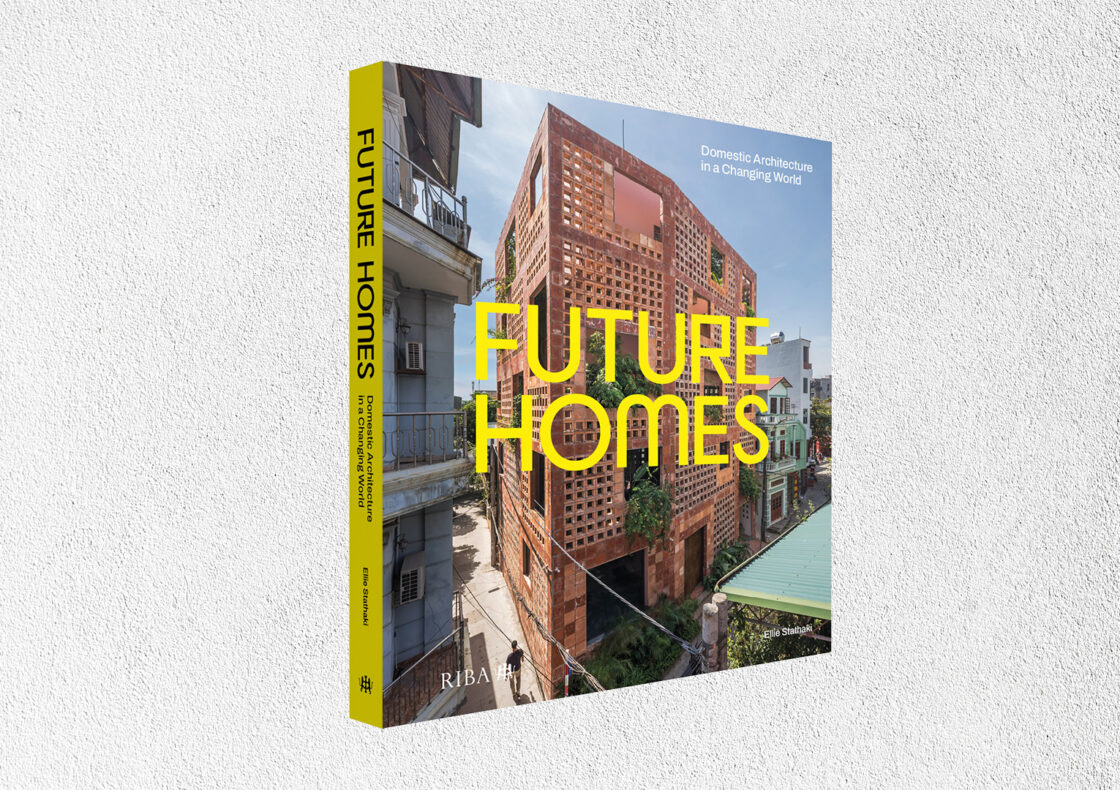
What should the future of the home be?
Join the author of Future Homes (RIBA Publishing, 2026), Ellie Stathaki, in conversation with architects Liz Tatarintseva (ao-ft), Tara Gbolade (Gbolade Design Studio) and Hannah Towler (Studio Bark) to explore what the needs of today can tell us about the house of tomorrow – and how we can create homes that are sustainable, generous, adaptable and beautiful.
Drawing on the panellists’ innovative work on single-family houses, this event will discuss the realities of broader residential architecture today, reflecting on what needs to change, and open a conversation about how we live. Fittingly set within the Museum of the Home, talking points will include: what defines a “future home” today? How are domestic spaces changing? How do we improve today’s homes?
Future Homes will be available to purchase at the event with a book signing opportunity after the panel.
Ellie Stathaki is a writer, editor and the Architecture and Environment Director at Wallpaper*. She trained as an architect at the Aristotle University of Thessaloniki in Greece and studied architectural history at the Bartlett in London. Now an established journalist, she has been a member of the Wallpaper* team since 2006, visiting buildings across the globe and interviewing leading architects such as Tadao Ando and Rem Koolhaas. Ellie has also taken part in judging panels, moderated events, curated shows and contributed to or authored books, such as The Contemporary House (Thames & Hudson, 2018), Glenn Sestig Architecture Diary (Oscar Riera Ojeda Publishers, 2020), House London (Frances Lincoln, 2022), and Future Homes (RIBA Publishing, 2026).
Tara Gbolade is a Mayor’s Design Advocate and co-director of award-winning Gbolade Design Studio -an architecture & urban design practice specialising in residential and mixed-use developments for public and private sector clients through data-led placeshaping. Tara is a Trustee of the UK Green Building Council (UKGBC) and sits on Design Review Panels across London where she advises councils on major planning applications. With an expertise in sustainable design, Tara has led public-sector sustainability guidance; setting the ambition and standards for Environmental & Socio-Economic sustainability ensuring that high quality sustainable design is embedded within new and existing development &communities. She is a contributor to industry-leading organisations including LETI & Architects Declare is encourages the adoption of Regenerative approaches to development.Tara is a co-founder of the Paradigm Network: championing diverse representation in the built environment; and is the authorof“Changing the Game: how to run a sustainable and regenerative small practice”
Liz Tatarintseva is the co-founder of ao-ft, a London based architecture office that focuses on crafting buildings for the well-being of its inhabitants through the use of renewable materials. Liz studied at the Architectural Association and worked at Gianni Botsford Architects and AL_A before setting up ao-ft with Zach Fluker in 2017.
Her work and research into urban housing constructed from timber resulted in the development of Spruce House and Studio, an infill house built in Cross Laminated Timber. Conceived as a prototype for sustainable housing, the project received a RIBA National Award, Wood Award and NLA Housing Award. Further to her work within the practice, Liz regularly contributes to teaching and reviewing student work at UCL The Bartlett and Cardiff University.
Hannah Towler uses natural materials and zero carbon building methods to create sensitive, contextual architecture. She leads Studio Bark’s rural planning policy research, producing user-friendly databases and articles to explain exemption clauses Paragraph 84 and Paragraph 139; helping our team, clients, and peers use these policies to create exceptional, sustainable rural architecture.
On projects, Hannah led Sun Barn, a barn conversion integrating complex planning constraints and innovative solar principles; and Quiet House, a Paragraph 84 home designed for neuro-inclusivity. She has also led on SmallCarbon user experience, focused on making carbon counting accessible for all.
Hannah’s experience on community construction projects in France and Portugal – working with straw bale and cob – has given her a practical understanding of off-grid, low-impact building techniques and the importance of community-led design. Before joining Studio Bark, Hannah worked at Waugh Thistleton Architects, and studied architecture at the University of Sheffield and the University of Westminster.